Frameless makes a strong first impression. It looks polished, ambitious, and visually rich in a way that suggests something substantial. But that impression does not quite hold. Once inside, it becomes clear that what is on offer is less a cohesive experience and more a series of looping projection rooms. There are moments where it works, but without structure or progression, it struggles to stay engaging for long.
Entry is quick, almost to the point of feeling abrupt. I arrived at 12:31 and was inside within minutes. There is an attempt at a build-up with an escalator and a dim corridor, though small details like visible adverts interrupt the atmosphere before it has a chance to settle.
Inside, the space opens into a sequence of large projection rooms. You move freely between them, with no set route and no real guidance. Each room runs on a continuous loop, but there is no indication of when a sequence begins or ends. More often than not, you walk in halfway through and try to piece together what you are looking at. That lack of structure defines the visit. Nothing really builds. Each room feels like a reset rather than a continuation.
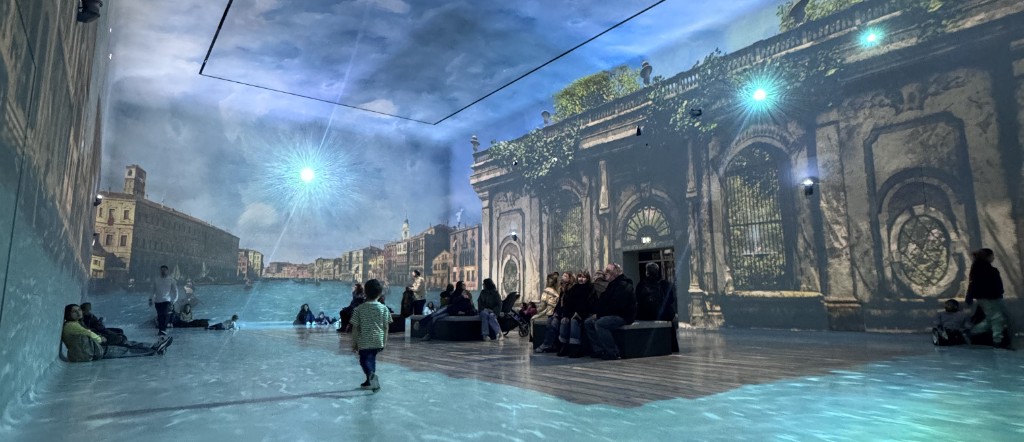
"The World Around Us" is where things come closest to what the experience promises. The angled projection walls create a space you can move through rather than just observe, and it feels calmer and more absorbing as a result. There are also brief moments where a sense of progression appears. The historical towns and cities sequence stands out for this, offering something closer to a narrative rather than a loop.
"Colour in Motion" is immediately engaging. The interactive floor draws people in quickly and gives a glimpse of what the experience could have been with more variation.
The issue is not any single room, but how similar they begin to feel. After a while, the format becomes predictable. Without a clear thread tying things together, the experience flattens out rather than building momentum. The loop system adds to this. Entering mid-way removes context, and there is no obvious way to reset or catch a full sequence. Some of the visuals also feel less refined than expected. Given the pricing and presentation, there is an expectation of something more current.
Crowds have a noticeable effect on how this feels. The rooms are open and dark, so movement is constant and hard to ignore. It becomes difficult to fully settle into any one piece. The interactive areas amplify this. The floor-based installation in particular becomes chaotic, with children running through and frequent interruptions. It looks family-friendly, but in practice it can feel overstimulating.
There are strong visuals here, but they do not translate easily into photos. Low lighting and constant movement make it difficult to get clean shots. It is one of those experiences that works better in the moment than through a camera.
The space is clean and well presented, but the balance feels off. The café and shop take up a noticeable amount of space relative to the exhibition itself. WiFi is available, though awkward to connect to, and staff are largely absent once you are inside.
I paid £26.19 on a discounted ticket. At that price, it feels reasonable. At full price, it becomes harder to justify, especially given the repetition and lack of structure.